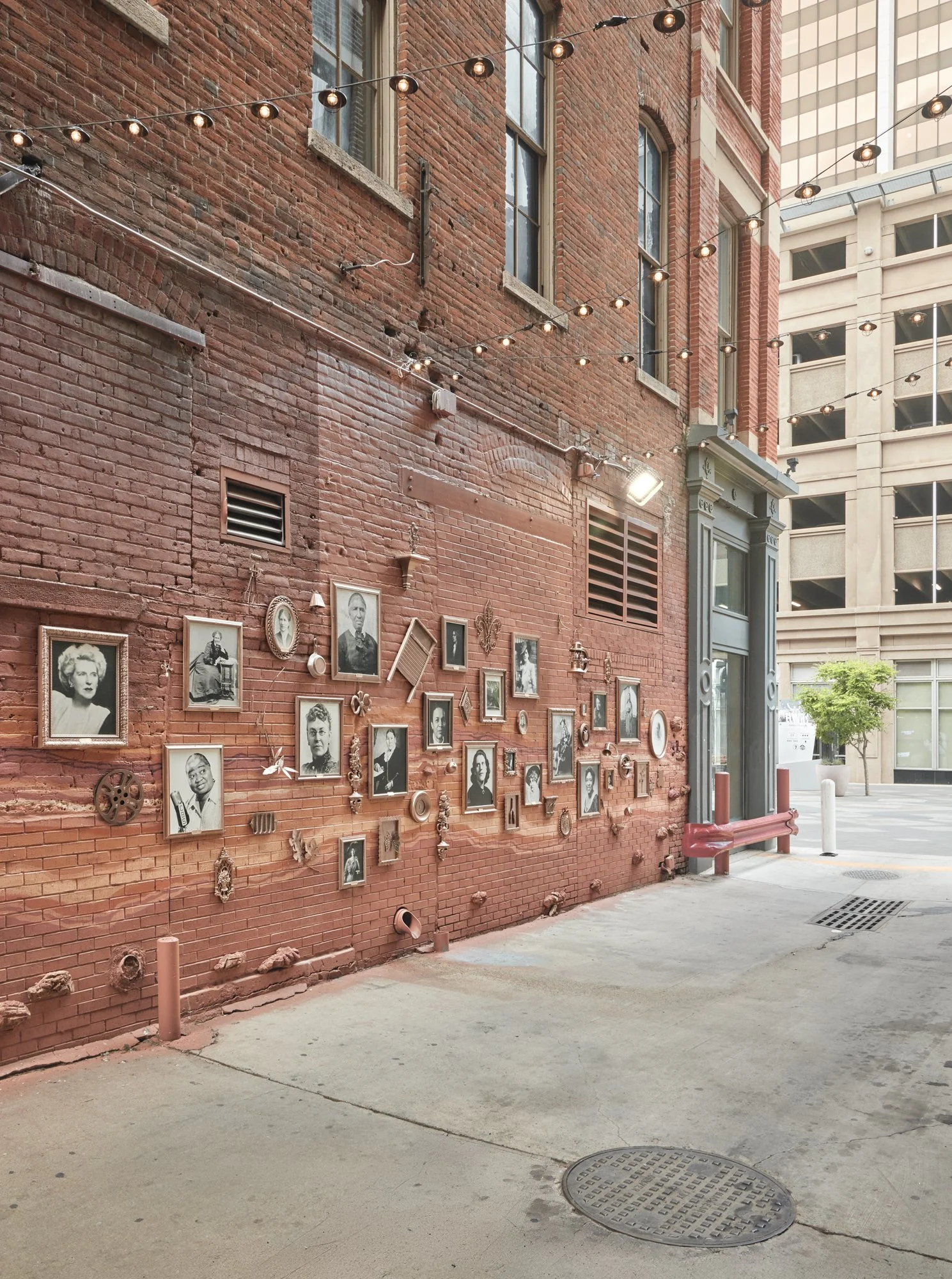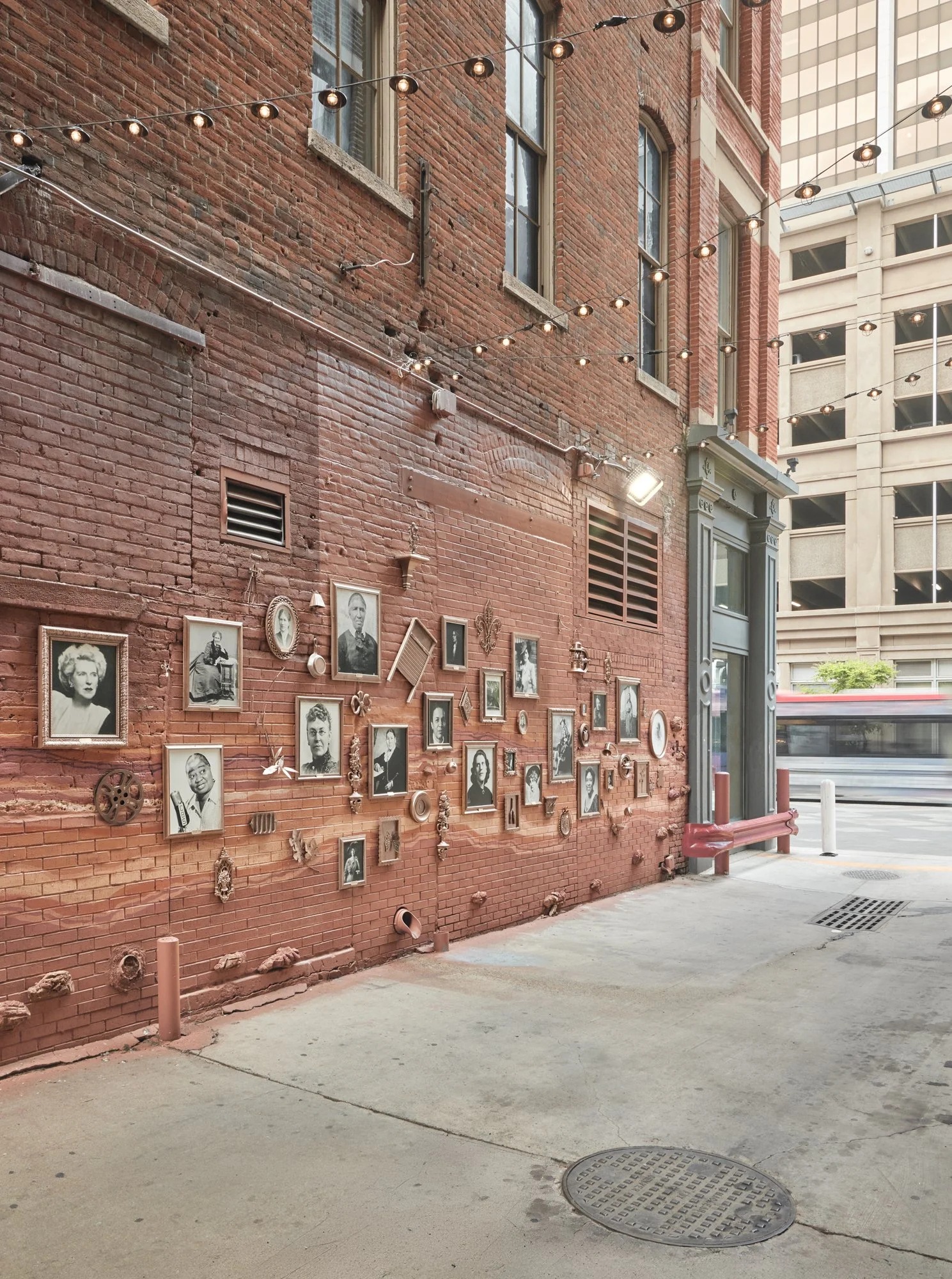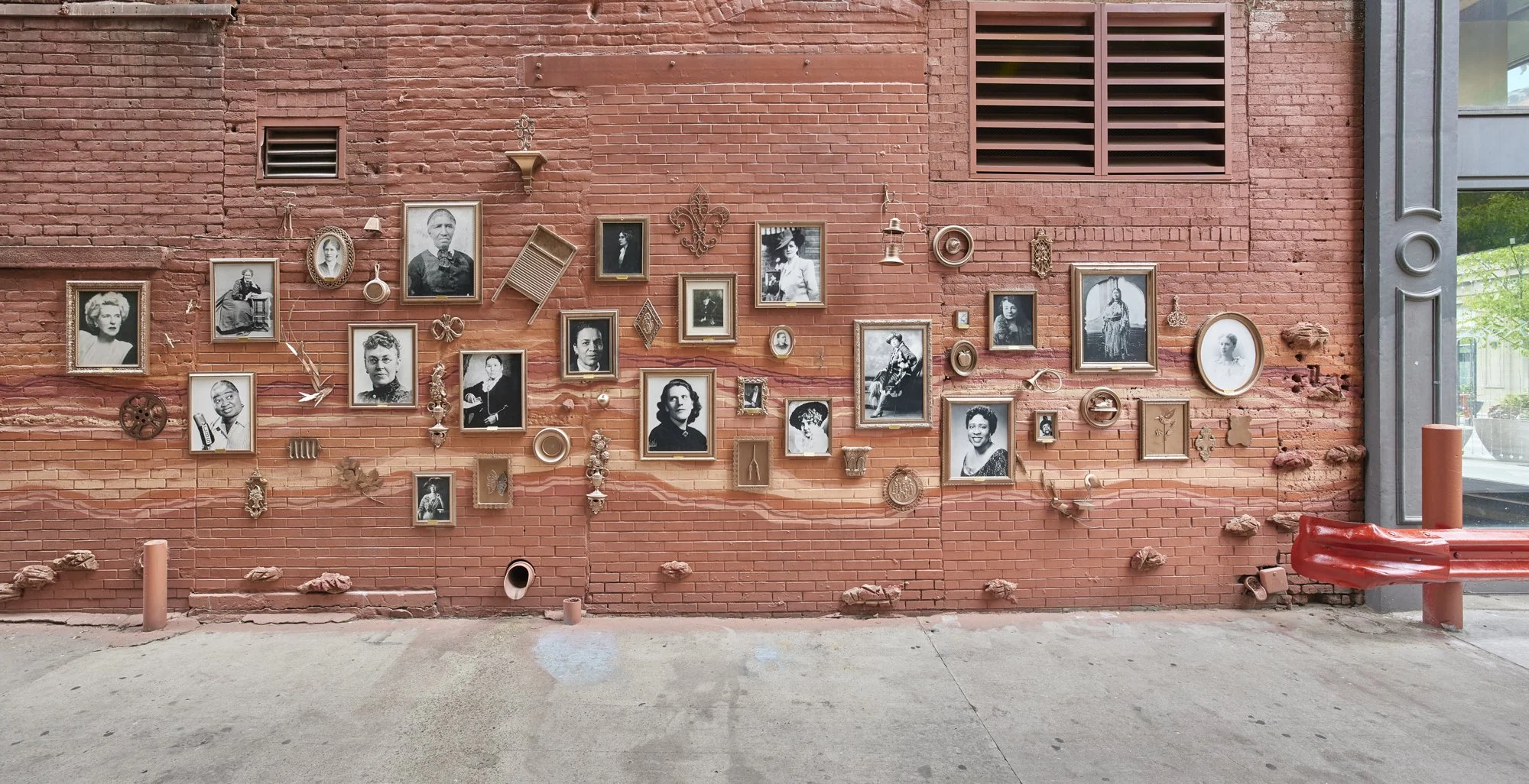
Aluminum Dibond prints, found frames, found objects, paint
16th St between Curtis and Champa (in the alley by Casa Tequila’s)
Trailblazers celebrates 25 women born before 1925 who carved a path for all Coloradans who follow in their footsteps.
Urban Canyons, the 2025 edition of Between Us: The Downtown Denver Alleyways Project, transforms alleys into canyons inspired by Colorado’s iconic red rock formations like those at Red Rocks Park and Garden of the Gods.
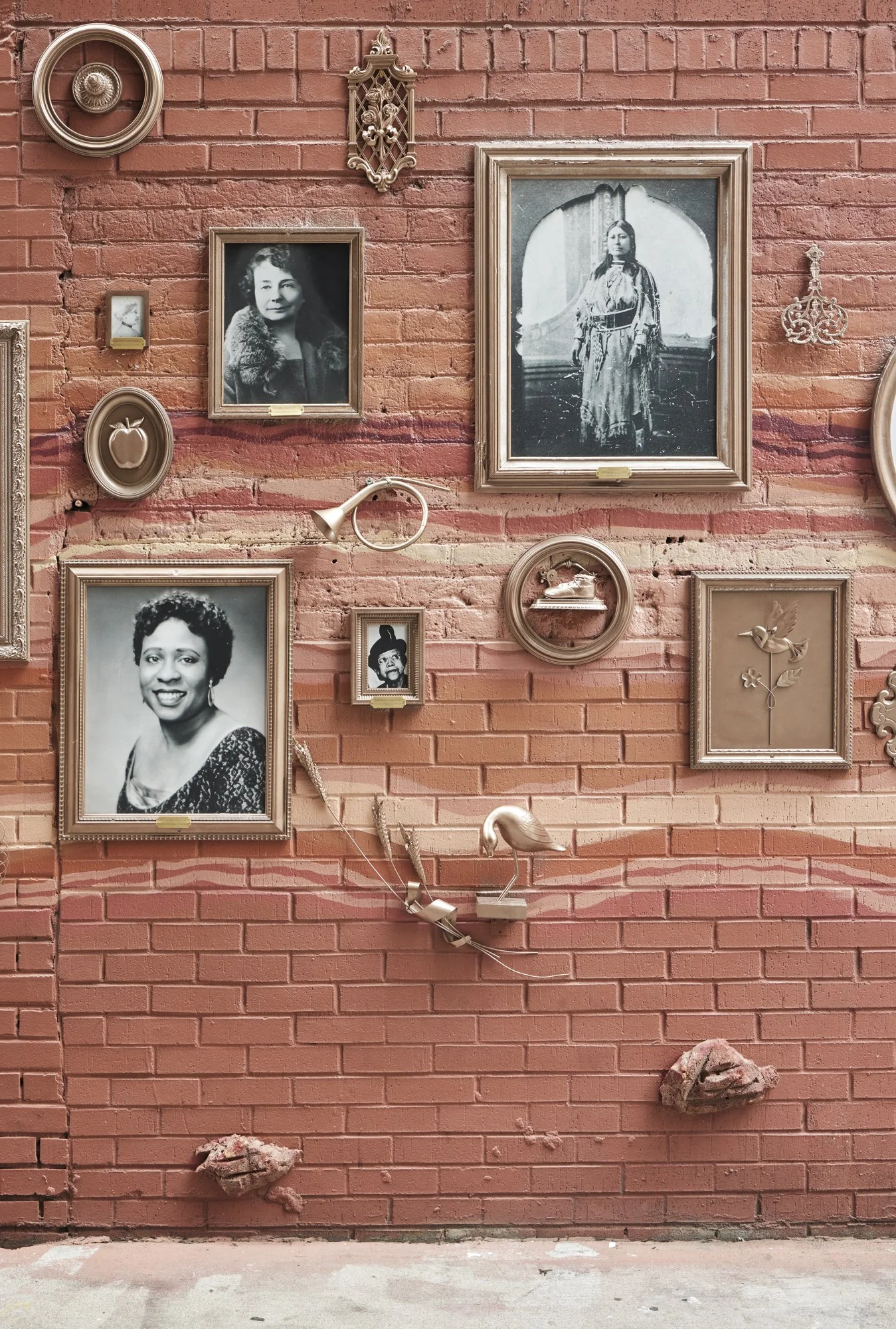
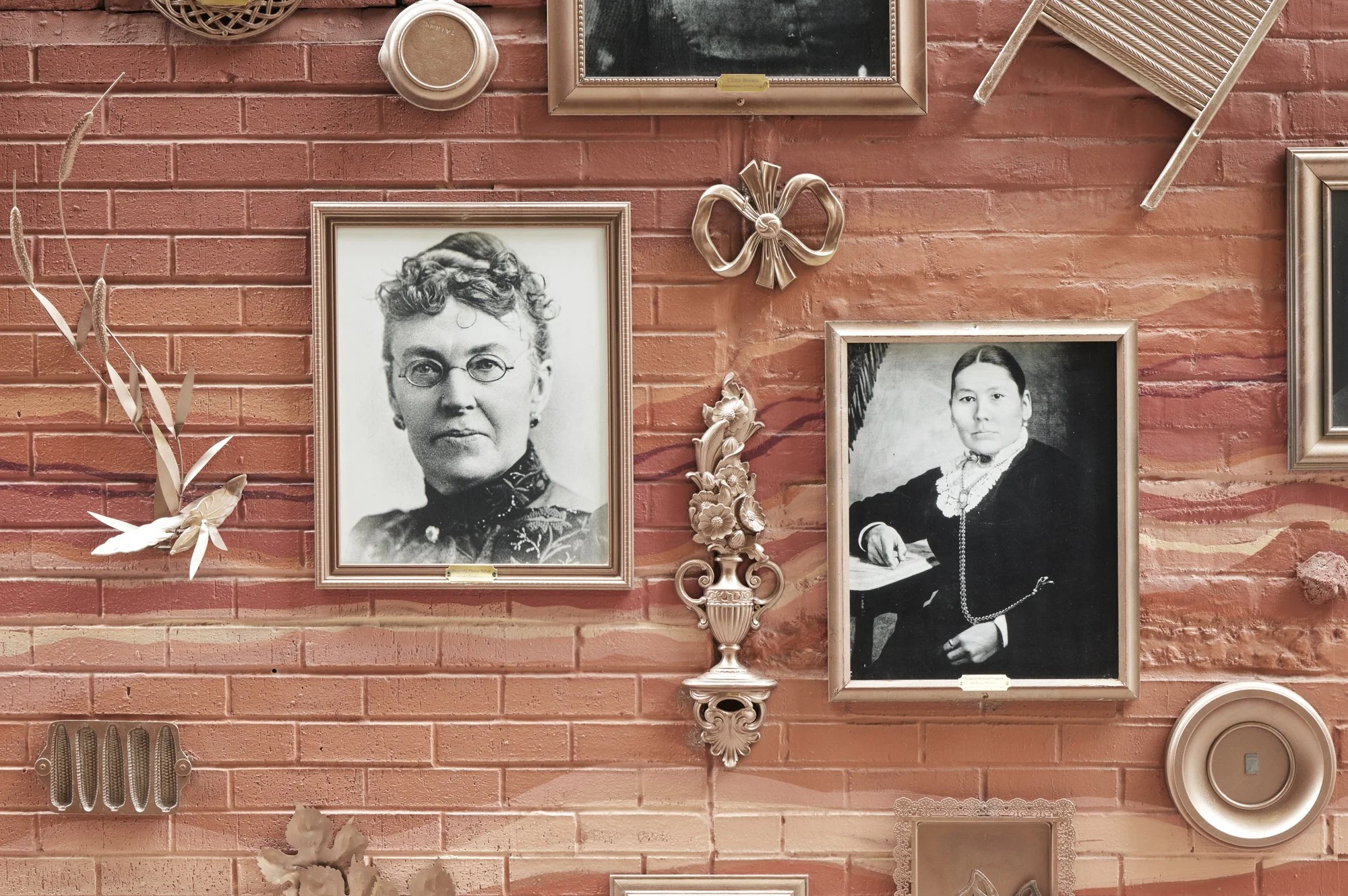
Trailblazers spotlights 25 women who blazed new paths across Colorado in education, the arts, philanthropy, politics and science. Many of the found objects represent these women’s origin stories and lifelong projects. Each portrait includes a name plate with three words that describe the woman pictured.
Women and symbolic objects featured in the installation appear below in alphabetical order by first name.
Amache Ochinee Prowers (Walking Woman)
(c. 1846–1905)
After her father was killed at the Sand Creek Massacre, she became a skilled cultural mediator and helped run her family’s cattle ranch. The Sand Creek Massacre site token and cowbell represent her.
Anne Evans
(1871–1941)
Anne Evans helped found some of Colorado’s most important cultural institutions like the Denver Art Museum, Denver Public Library and Central City Opera. The Byers-Evans House, where she lived with her brother and mother, is now home to the Center for Colorado Women’s History.
Antonia Brico
(1902–1989)
Antonia Brico was an accomplished pianist and conductor, breaking gender barriers at renowned symphonies across the world to acclaim. She founded what is now the Denver Philharmonic. The diamond-shaped piece with a violin represents her.
Augusta Pierce Tabor
(1833–1895)
Augusta Tabor was an entrepreneur and philanthropist. She supplemented her husband’s mining efforts as a laundress and landlady for 20 years before he struck it rich. Later in life, she helped pioneer women in need through the Pioneer Ladies Aid Society.
Caroline Bancroft
(1900–1985)
Born to high society, Caroline Bancroft paved her own path. She danced in the Ziegfeld Follies, taught on a cruise ship and wrote for The Denver Post before focusing her attention on Colorado history. She wrote almost two dozen books about Colorado. The wire dress represents her.
Chipeta (White Singing Bird)
(1843 or 1844–1924)
Chipeta, born into the Kiowa Apache tribe and later adopted into the Ute tribe, served as an advocate and diplomat for Indian rights. She could speak Ute, Spanish and English. The bird next to the wheat grass represents her.
Clara Brown
(c. 1800–1885)
The “Angel of the Rockies” was Colorado’s first Black settler and a successful entrepreneur. The washboard represents her start in Central City as a laundress, cook and midwife. Born into enslavement, she helped people new to freedom relocate to Colorado, never turning away anyone in need.
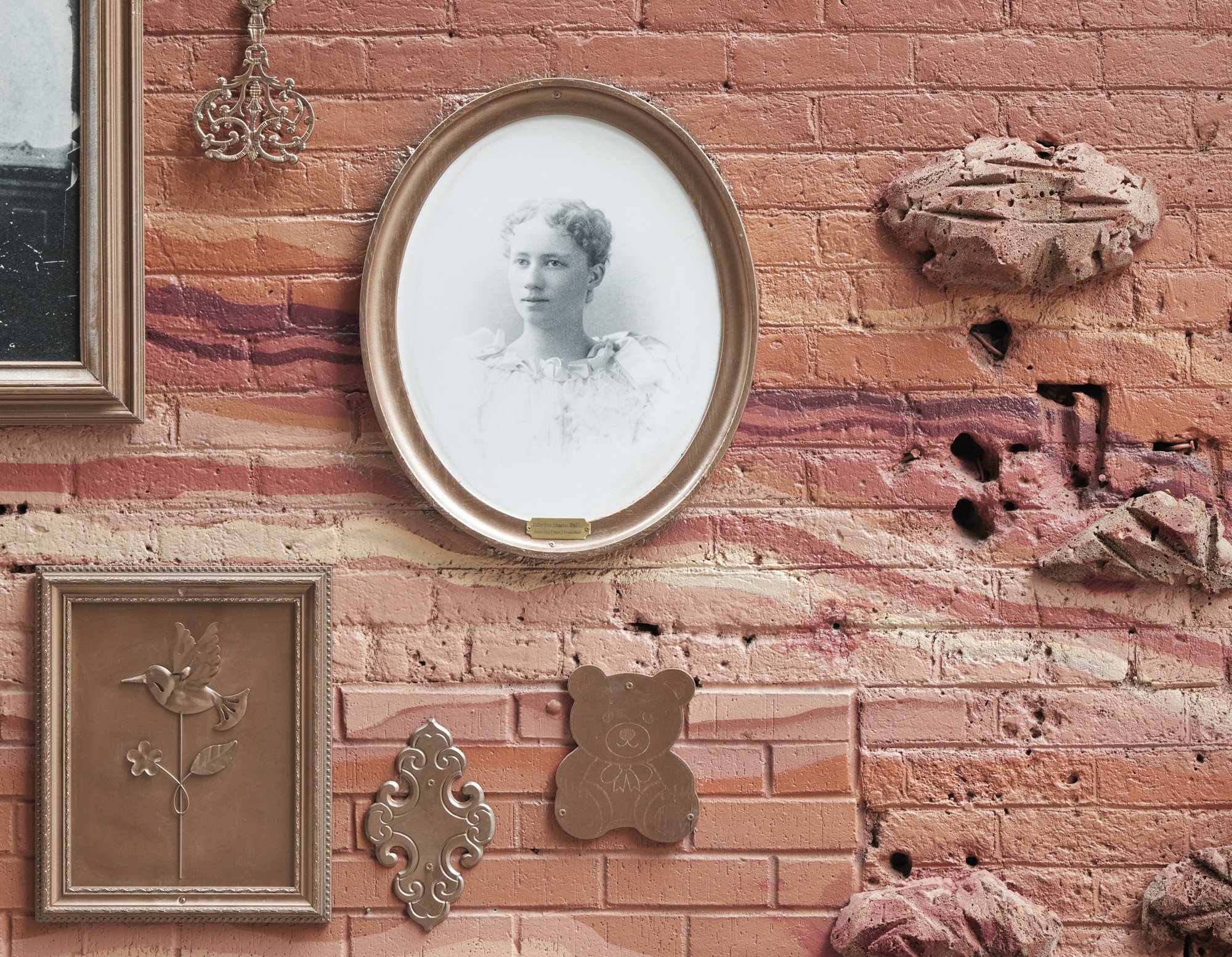
Edwina Hume Fallis
(1876–1957)
Edwina Hume Fallis was an exemplary Denver teacher who also founded an educational toy company. She was a prolific writer, first writing for textbooks and fellow teachers before transitioning into a children’s book author and poet. The teddy bear represents her.
Elizabeth McCourt “Baby Doe” Tabor
(1854–1935)
Elizabeth McCourt “Baby Doe” Tabor is known for her rags-to-riches-to-rags story. She was a beauty, flirty, flamboyant, a divorcee, a mistress and one of Leadville’s most iconic inhabitants. She defied norms and survived scandal but lived the end of her life in isolation and poverty. The curling iron represents her.
Elizabeth Piper Ensley
(1847–1919)
Elizabeth Piper Ensley was a teacher, activist, journalist and suffragette. Her efforts helped Colorado become the second state in the nation to allow women the right to vote in all elections in 1893. The apple in the oval frame represents her and Emily Griffith.
Emily Griffith
(1868–1947)
As a pioneer in adult education, Emily Griffith founded the Opportunity School—what’s now the Emily Griffith Opportunity School—to help working adults learn practical skills like masonry and dressmaking. The apple in the oval frame represents her and Elizabeth Piper Ensley.
Fannie Mae Duncan
(1918–2005)
Fannie Mae Duncan was an entrepreneur, activist and philanthropist in Colorado Springs. Her jazz club, The Cotton Club, hosted great musicians like Duke Ellington, Etta James and Billie Holiday, among others. The Cotton Club was one of the earliest racially integrated jazz clubs.
Florence R. Sabin
(1871–1953)
Florence R. Sabin was a pioneering physician and scientist whose discoveries helped us better understand the lymphatic system. She was the first woman to hold a full professorship at Johns Hopkins University and be elected to the National Academy of Sciences. She moved to Colorado for her retirement and led public health efforts to treat and reduce tuberculosis.
Frances Wisebart Jacobs
(1843–1892)
Frances Wisebart Jacobs was an entrepreneur and philanthropist. She is best known for founding the United Way and Denver’s Jewish Hospital Association. Despite personal tragedies, she was resilient and persuasive with a strong sense of humor. She was known nationwide as the “Mother of Charities” for her impressive work in Denver.
Hattie McDaniel
(1893–1952)
Hattie McDaniel was an actor, singer/songwriter and comedienne who spent 30 years in Colorado. A true trailblazer, she was the first Black woman to sing on the radio in the United States and the first Black person to win an Academy Award for her role as Mammy in Gone with the Wind. She has two stars on the Hollywood Walk of Fame. The film reel represents her.
Helen Gilmer Bonfils
(1889–1972)
Helen Gilmer Bonfils was an executive at The Denver Post, an actor, producer and philanthropist. She acted in theatrical productions in Denver and on Broadway and co-produced shows in both places as well as London. She contributed to numerous local art, health, education and humanitarian causes. The drama and comedy masks represent her.
Helen Hunt Jackson
(1830–1885)
Helen Hunt Jackson was a prolific novelist, poet and activist for Native Americans. She fought for federal policy reform. She came to Colorado Springs to recover from tuberculosis. One of her most popular poems is Cheyenne Mountain. Colorado College houses her largest collection of papers.
Justina Laurena Ford
(1871–1952)
As the first licensed Black female doctor in Denver, Dr. Ford practiced gynecology, obstetrics and pediatrics from her home in Five Points. The baby shoe represents the nearly 7,000 babies she delivered over the course of her 50-year career.
Martha Maxwell
(1831–1881)
Martha Maxwell was a naturalist, artist and taxidermist whose modernist approach to taxidermy forever transformed the natural history museum diorama. She invented a new approach to taxidermy using wood and metal armatures and plaster to give them a more life-like appearance.
Mary Coyle Chase
(1906–1981)
Mary Coyle Chase was a Pulitzer-Prize-winning author and journalist. She’s best known for the Broadway play and film, Harvey, and wrote 13 other plays, two children’s novels and a screenplay. She also wrote for the Rocky Mountain News.
Mary Elitch Long
(1856–1936)
Mary Elitch Long was the first woman to own and manage a zoo and one of the first to own and manage a theater. Known as the Lady of Elitch Gardens, she transformed the land into a cultural resort with animals, plants and entertainment. The butterfly represents her.
May Bonfils Stanton
(1883–1962)
May Bonfils Stanton was an accomplished composer and pianist in addition to being a major philanthropist across the Front Range. The Bonfils-Stanton Foundation was created in her honor. The fleur-de-lis represents her estate modeled after Marie Antoinette’s chateau in Versailles.
Molly Brown
(1867–1932)
The “Unsinkable Molly Brown” survived poverty and the Titanic to become one of Denver’s most iconic socialites and philanthropists. The mining lamp hanging over her portrait represents the mining engineering efforts that made her wealthy.
Rachel B. Noel
(1918–2008)
Rachel B. Noel was a dedicated educator, politician and civil rights advocate to integrate the Denver school district. She was the first Black woman elected to public office in Colorado. The apple on the stack of books represents her.
Theodosia Grace Ammons
(1861–1907)
As the first female faculty member and dean at Colorado Agricultural College (now Colorado State University), Theodosia promoted scientific methods for cooking, hygiene and residential architecture. The whisk and skillet represent her legacy.